

Kids Table and Chair Height Guide: How to Set Up a Healthy Home Desk
Kids Table and Chair Height Guide: How to Set Up a Healthy Home Desk
Children spend a large part of the day sitting: eating, drawing, reading and doing homework. When the table and chair are the wrong height, the body pays for it. A child whose feet dangle will slide forward, curl over the page and prop their head on one hand. Over months that means tired shoulders, a sore neck and a slouching habit that is hard to undo. Setting the right height takes a tape measure and about five minutes, and even a two-year-old can be made comfortable.
Why the right height matters more than you think
Sitting well is not about forcing a straight back; it is about letting the body rest. When the chair supports the thighs and the feet rest flat, the hips open to roughly a right angle and the spine keeps its natural curve with very little effort. If the seat is too high, the legs hang and their weight pulls the pelvis into a slump. If the table is too low, the child folds forward to reach the page. Both positions strain the neck and lower back and make writing and drawing harder than they need to be.
Five quick checks for any desk and chair
1. Feet flat. Both feet rest fully on the floor, or on a footrest or box set at the right height. Nothing dangles.
2. Knees and hips. Thighs are roughly parallel to the floor, with knees and hips at about 90 degrees. A little more is fine.
3. Elbows. With the shoulders relaxed, the elbows sit at or just above the table top. If a child has to lift the shoulders to reach, the table is too high; if the elbows sit well above the surface, it is too low.
4. Eyes. The book or screen is about 30 to 40 cm (12 to 16 inches) from the eyes, held up on a stand or propped, not lying flat on the desk.
5. Back support. The backrest touches the lower back, and the seat is short enough that the child does not have to sit forward to reach it.
Starting heights by age
These are starting points, not rules. Children of the same age differ a lot in height, so measure the child and finish with the five checks above.
| Age | Table top height | Chair seat height |
|---|---|---|
| 2 to 4 years | 40 to 45 cm (16 to 18 in) | 22 to 26 cm (9 to 10 in) |
| 4 to 6 years | 46 to 52 cm (18 to 20 in) | 26 to 30 cm (10 to 12 in) |
| 6 to 8 years | 53 to 58 cm (21 to 23 in) | 30 to 34 cm (12 to 13 in) |
| 8 to 10 years | 59 to 64 cm (23 to 25 in) | 34 to 38 cm (13 to 15 in) |
| 10 to 12 years | 65 to 70 cm (26 to 28 in) | 38 to 42 cm (15 to 17 in) |
Signs the setup is wrong
Watch for feet that swing or tuck behind the chair legs, a child who sits on one foot, knees higher than the hips, elbows below the table, a head resting on one hand, or a child who keeps sliding forward. Tiredness in the neck, shoulders or back after sitting, and handwriting that gets messier as the session goes on, are other clues. Any one of them is worth a two-minute adjustment.
Adjustable beats fixed
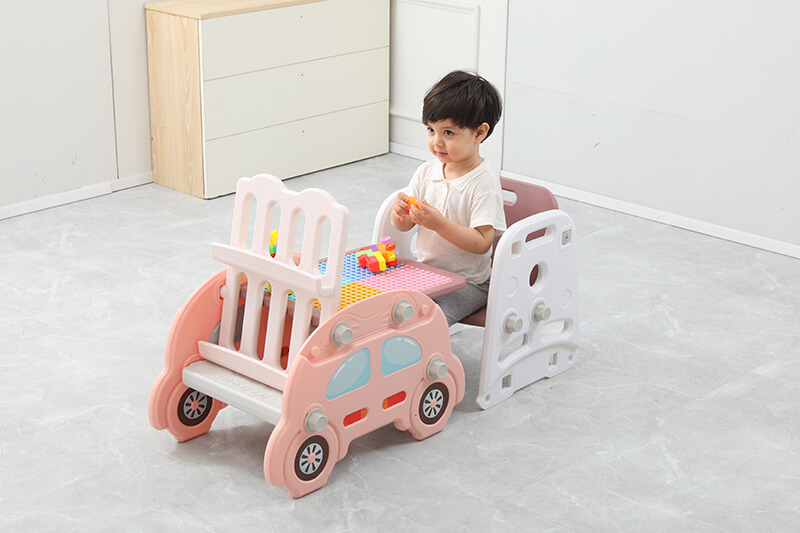
Children grow roughly 5 to 7 cm a year, so a desk that fits in September may be a poor fit by the following summer. Adjustable desks and chairs, or a fixed chair with a removable cushion and a firm footrest, let you keep pace with a growing child. Check and reset the setup two or three times a year.
Common mistakes
Letting siblings of different sizes share one fixed desk; seating a young child at a dining table with an adult chair and no footrest; buying a set to grow into that is two sizes too big now; and leaving a tall child at a small toddler table. A simple footrest is the cheapest fix for a child whose feet do not yet reach the floor.
When to ask for more than a tape measure
Most posture wobbles are solved by the right heights. If a child keeps complaining of pain, holds their head or shoulder to one side, or has a posture that worries you, mention it to your doctor or a paediatric physiotherapist rather than waiting for them to grow out of it.
Getting the heights right is a small job with a big payoff: a calmer, more comfortable child and work that is easier to concentrate on. For more on furnishing a space for young children, see our notes on choosing kindergarten tables and chairs and on climbing toys for toddlers.
发表评论
Want to join the discussion?Feel free to contribute!