

How to Choose a Kids Rocking Horse: Stability, Materials and Age Fit
A rocking horse looks like the simplest toy in the catalogue, which is exactly why so many buyers get it wrong. The three things that decide whether it sells or comes back — base width, floor contact and resin — are all invisible in a product photo, so here is what to check with a sample in hand.
Start with the base, not the horse
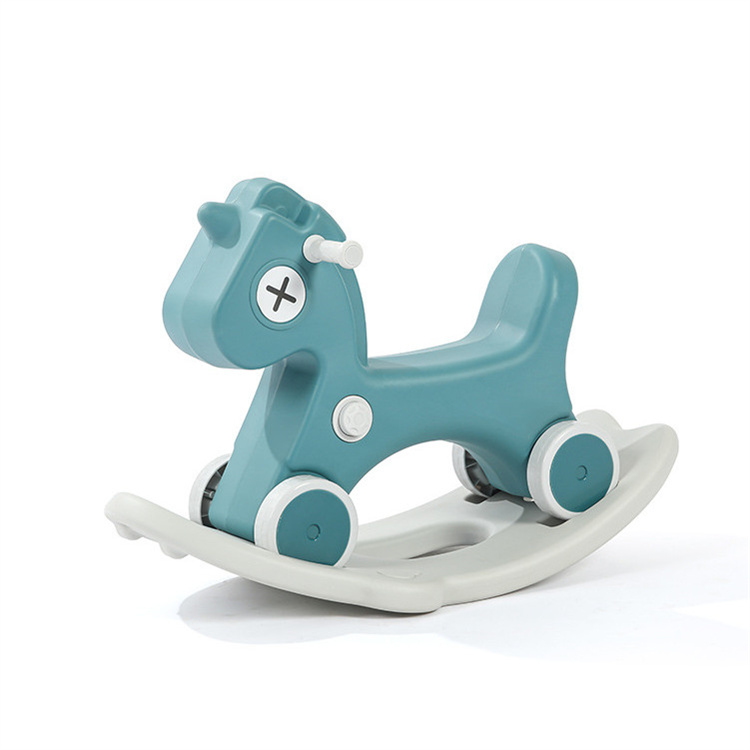
A base narrower than the seat will tip. Measure the distance across the two ends of the rocker and compare it with the seat width — the base should be visibly wider on both sides. A classic narrow rocker works on carpet where friction helps, and becomes unpredictable on tile or laminate where it does not.
Push the seat sideways by hand. A sample that lifts easily under a firm hand will lift with a child leaning over the edge to look at something on the floor. This takes ten seconds and rules out most of the bad samples before anything else is examined.
| Child’s stage | What actually matters | What to walk away from |
|---|---|---|
| 12–18 months | Low seat, wide base, no small parts | Tall horses a toddler must climb onto |
| 2–3 years | Grip handles, footrests, four-point base | Two narrow runners that slide on tile |
| 3–5 years | Weight rating above 25 kg, thick shell | Thin hollow shells that flex underfoot |
| Wholesale order | Carton size, CBM, 40HQ quantity | Quotes without loading data |
Four contact points beat two curved runners
Flat contact points make the toy stable when nobody is holding it. A good design keeps the rocking arc but adds four flat pads underneath, so the horse sits level while a child climbs on and only rocks when they push. That matters most at the moment of mounting, which is when most tipping accidents happen.
Check the pads on a hard floor. If the sample wobbles, the mould or the assembly is out of tolerance, and a wobbling sample becomes a return from every customer who owns a tiled living room. Ask the factory what the tolerance is, then verify it on the sample rather than on the drawing.
Ask what the plastic actually is
“Eco-friendly plastic” is not a material. Ask for the resin by name: PE, PP or ABS. Ride-on toys are usually moulded in PE because it is tough, slightly flexible and survives being dropped, dragged and climbed on. Then ask for the reports behind the claim — EN71-1/-2/-3 for Europe, ASTM F963 for the United States — and check that the report covers the colour batch you are buying, not a sample from two years ago.
Smell is a useful field test. Freshly moulded PE has almost no odour. A sharp chemical smell suggests regrind or unregulated additives, and no certificate makes that acceptable for a product aimed at children under three.
Age fit is about reach, not height
A toddler should reach the handles with elbows slightly bent. If they have to stretch, they will lean forward and shift the centre of gravity; if the handles are at chest height, they cannot use them at all. Seat height matters for the same reason: feet should touch the floor, otherwise the child slides off rather than dismounts.
Convertible toys earn their shelf space. A rocking horse that also works as a sliding bike or a balance board covers roughly two years of development instead of one season, which is easier to justify at retail and reduces the number of SKUs a shop has to carry.
Edges, gaps and small parts
Run a finger along every moulded seam. Flashing that feels sharp on an adult hand is sharp on a toddler’s. Check the gaps around wheels, handles and decorative fittings: anything between 5 mm and 12 mm can trap a finger, and anything smaller than a ping-pong ball is a choke hazard if it can be pulled free.
Confirm how the parts are fixed. Handles, wheels and ears should be screwed or moulded in, not push-fitted. A determined two-year-old will find the one part that pulls off, usually in the first week.
Carton and loading, before you agree a price
Freight is part of the landed cost. Rocking toys are bulky relative to their value, so a toy that looks cheap per unit can lose to a slightly dearer one that loads twice as many sets per container. Ask for carton dimensions, CBM per set and the 40HQ loading quantity in writing. Confirm whether the carton is plain or printed, and whether assembly is needed on arrival.
Get the specification table in writing too. Model number, size, gross weight, age range and packing should all appear on the quotation, not just on the website, so that the container you receive matches the one you priced.
Where to start
Base width first, then floor contact, then resin, then age fit. Everything else — colour, shape, packaging — is decoration. Ten minutes with a sample and a tape measure is cheaper than a container of returns.
Related reading: Kids slide safety tips: 8 rules for safe sliding at home | Climbing frame safety at home: 8 rules for safe climbing | Cloud kids rocking horse 3-in-1
发表评论
Want to join the discussion?Feel free to contribute!